Hearing Tests
A hearing test breaks hearing down into measurable components.
Different pitches are assessed individually rather than treating hearing as one overall ability. Speech testing can add information about how spoken language is recognised, while examining the ears beforehand helps identify physical issues that might affect what you are hearing.
The resulting information needs interpretation.
A particular result might have little practical consequence for one person yet explain a very specific difficulty for somebody else. This is why we consider the audiology findings alongside the situations in which you actually rely on your hearing.
You will be shown what the assessment has identified and what, if anything, deserves attention.
There may be a reason to explore another service. There may simply be value in keeping the results for future comparison. There may be nothing that needs doing at present.
You can read more about Hearing Tests in Burnham-on-Sea on our dedicated service page.
Hearing Aids
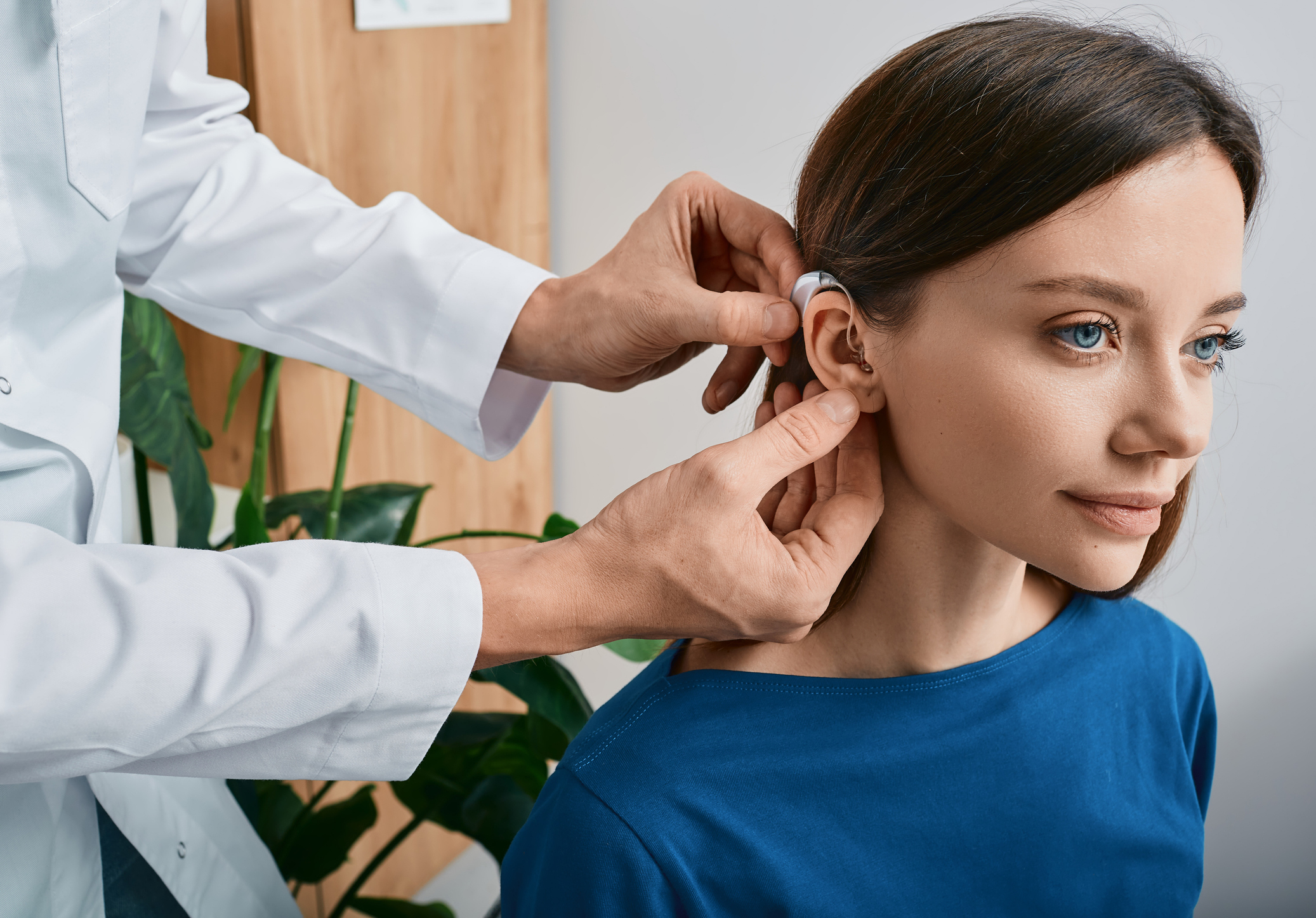
Hearing aids are useful when they solve genuine listening problems.
That might mean catching the beginning and end of words more reliably, hearing somebody without needing to look directly at them or picking up useful sounds from elsewhere in the room.
The objective is not maximum amplification. More sound is not automatically better sound.
Where hearing aids are suitable, assessment results are used to determine what amplification is required across different parts of the hearing range. We then consider the environments in which the devices will be used before selecting and programming an appropriate solution.
Meadows & Wood operates independently, giving us scope to consider hearing technology from different manufacturers according to its suitability for the individual.
After fitting, your experience becomes part of the process. Real-world use can reveal where a setting needs refinement in a way that an appointment alone cannot.
Our Hearing Aids in Burnham-on-Sea page explains more about how hearing technology can restore details that may have gradually disappeared from everyday sound.
Tinnitus Assessment
Tinnitus often generates questions before it generates answers.
Does the sound mean hearing has been damaged? Why has it appeared now? Is it significant that it is more noticeable on one side? Does a change mean something is getting worse?
The sound alone cannot reliably answer those questions.
A tinnitus appointment gives us an opportunity to examine the ears, assess hearing and explore relevant background information before deciding whether any particular finding deserves attention.
This is especially important because tinnitus is a symptom rather than one single condition with one single explanation.
Our role is therefore not to attach meaning to tinnitus prematurely. It is to gather relevant information and distinguish between what the assessment actually demonstrates and what might otherwise be assumed.
Visit our Tinnitus Treatment in Burnham-on-Sea page to learn more about how tinnitus is investigated and how appropriate next steps are determined.
Ear Wax Removal
The presence of wax inside an ear is not, by itself, a reason to remove it.
Wax becomes relevant when there is enough of it to obstruct the canal, interfere with hearing, affect hearing aid use or contribute to other difficulties.
An ear examination allows us to see whether that threshold has been reached.
Where removal would be beneficial, microsuction enables problematic wax to be taken away while the practitioner maintains a clear view inside the canal. Treatment is therefore directed at the obstruction rather than trying to leave every ear completely free of wax.
If the examination does not support wax as the explanation for what you have noticed, removing it unnecessarily would not solve the problem. We can instead consider whether another form of hearing care is appropriate.
Find out more on our Ear Wax Removal in Burnham-on-Sea page.